



Cedalion unites optical brain imaging tools in a single Python framework
Researchers from BIFOLD / TU Berlin and Boston University have published a comprehensive tutorial on Cedalion, an open-source project that brings together analysis tools for multimodal neuroimaging, with a special focus on fNIRS and DOT data. The paper, which is accompanied by seven fully executable Jupyter notebooks, appeared on 13 August 2026 in the journal Neurophotonics. A hands-on community workshop follows on 24–25 August in Berlin and online.
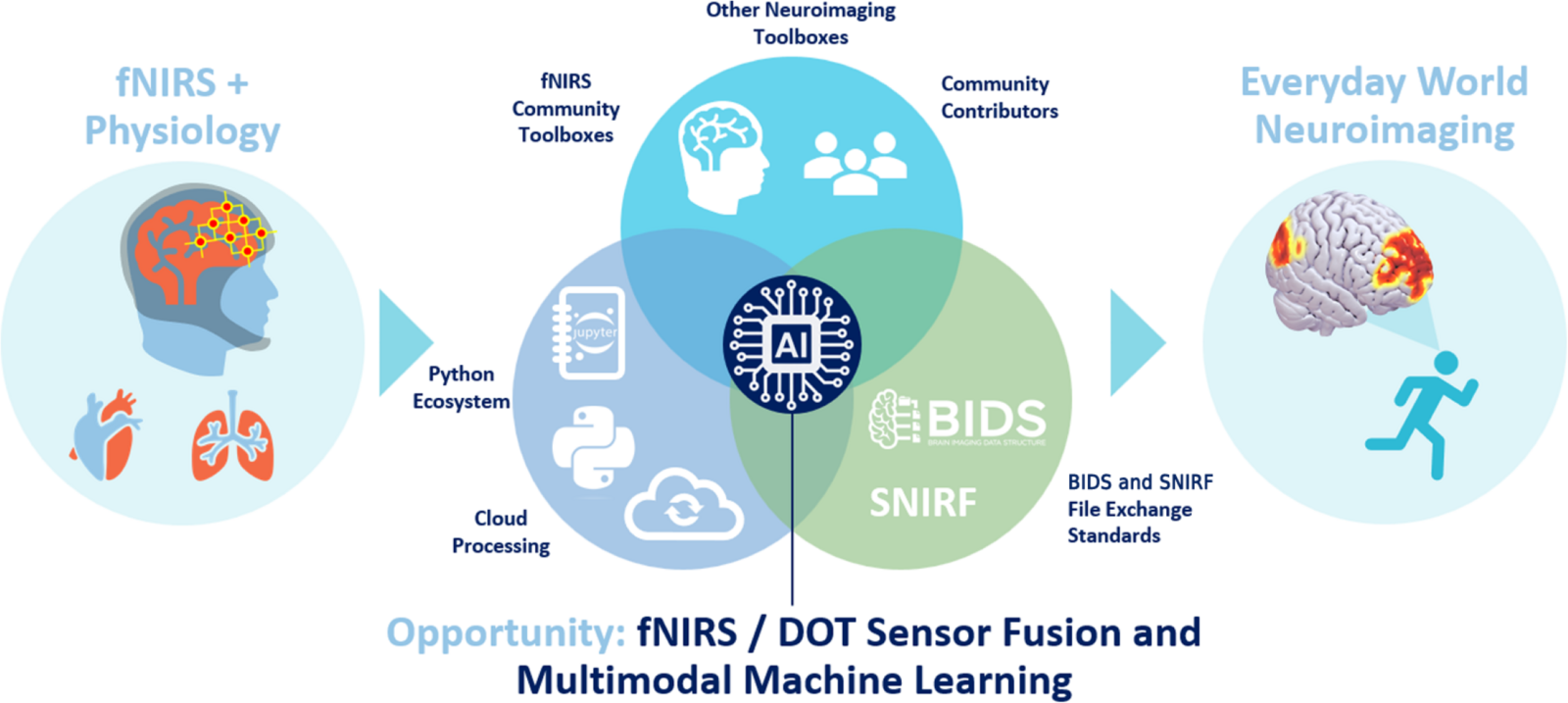
Functional near-infrared spectroscopy (fNIRS) measures brain activity optically based on changes in cortical blood flow. Unlike magnetic resonance imaging, the technique is wearable, so it can be used during movement and outside the lab. Diffuse optical tomography (DOT) extends this principle with improved spatial and depth information. Both are often combined with other modalities such as electroencephalography (EEG) physiological signals to obtain a more complete picture of brain activity in real-world contexts.
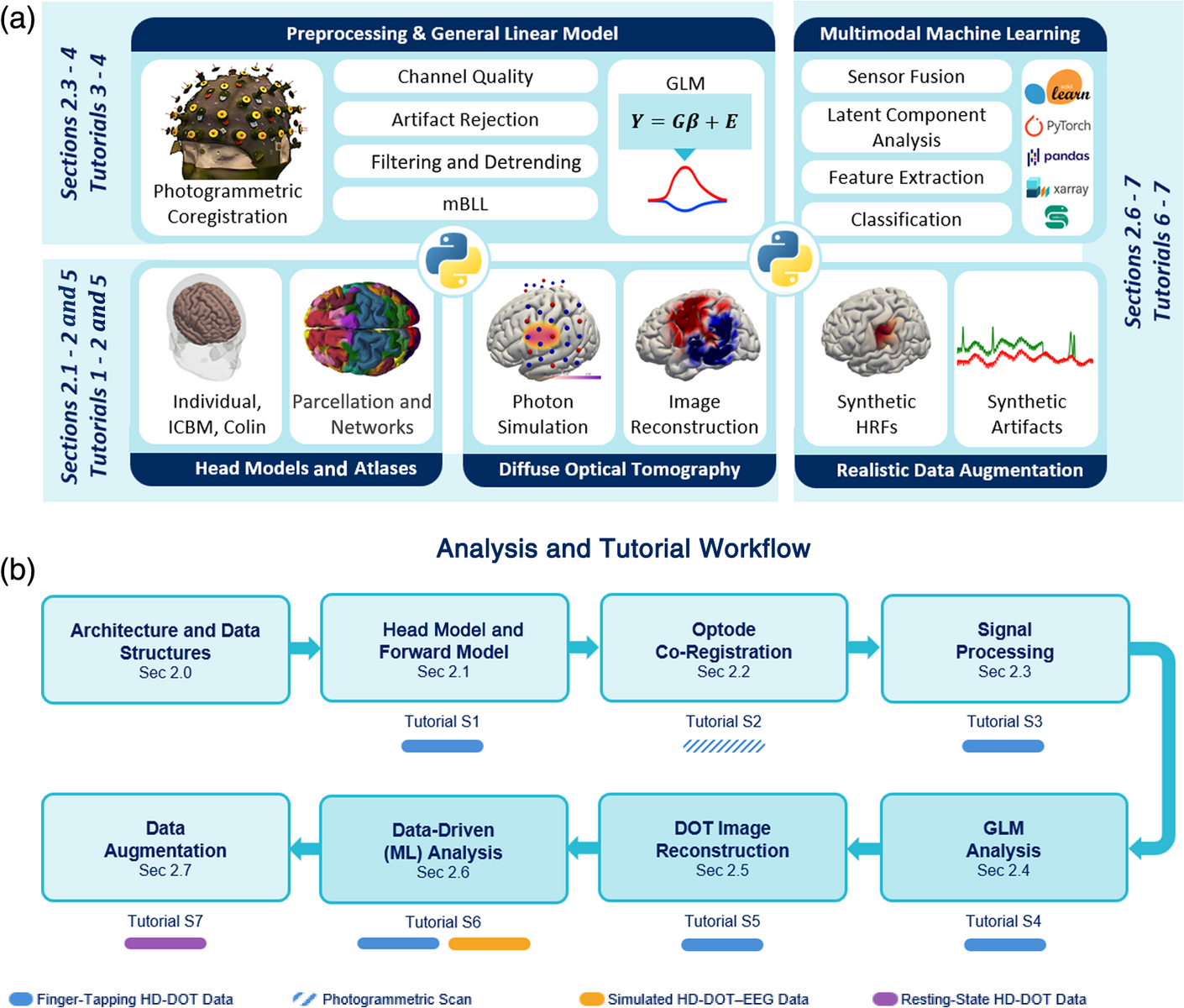
Researchers analyzing such data have had to stitch together fragmented tools across different software environments. Cedalion brings the entire analysis chain together in one framework and one language. This lowers the friction in everyday research: new methods can be developed and tested against existing ones in the same environment, complete workflows can be shared with a publication instead of being reassembled by hand, and popular machine-learning libraries connect directly. Cedalion integrates the simulation of light propagation in tissue, photogrammetric estimation of optode positions on the head, methods for assessing signal quality and correcting artifacts, statistical modeling of multimodal time series using general linear models (GLM), DOT image reconstruction, and data-driven machine-learning (ML) methods.
Built with and for the community
Cedalion is designed as a community-driven, open-source project. It builds directly on the widely used MATLAB tools Homer2/3 and AtlasViewer from Boston University, carrying decades of methodological experience into the Python ecosystem.
"We stand on the shoulders of the pioneering tools Homer2/3 and AtlasViewer, and build from there an open foundation for fNIRS research," says Alexander von Lühmann, head of the "Intelligent Biomedical Sensing" research group at BIFOLD / TU Berlin.
The tutorial publication is written for a broad audience of neuroscientists, engineers, and data scientists. The seven hands-on Jupyter notebooks accompanying the tutorial make it easy to get started. They walk readers through the framework and run in the cloud with no local setup required.
For guided training, a Cedalion workshop takes place on 24–25 August 2026 in Berlin and online as part of the MoBI Conference.
Only basic Python knowledge is required; no prior fNIRS experience is necessary. Registration and details: https://www.bifold.berlin/news-events/events/cedalion-workshop
Integration as a foundation for method development and machine learning
Bringing the existing analysis methods together in one framework also creates the technical precondition for new data-driven approaches. The classical analysis methods contribute physical and physiological knowledge - for example, by removing artifacts and turning raw light measurements into meaningful quantities - providing a better starting point for machine-learning methods which then extract patterns from these representations. Complementary signals from EEG or physiological sensors can be fused in, helping to separate brain activity from confounding influences and to improve the representations.
This enables applications in brain decoding, for example in brain-computer interfacing, neurology, or psychology.
“Cedalion provides fNIRS and DOT researchers with the tools to extract clean, meaningful representations from their data, which is what machine-learning methods need to work well,” says first author Eike Middell.
Potential applications range from basic research to clinical questions, such as bedside monitoring or tracking motor and cognitive tasks with wearable sensors during physiotherapy.
Facilitating reproducibility and interoperability
Cedalion aims to lower the effort of sharing complete, rerunnable analyses. The framework adheres to the open SNIRF and BIDS data standards and provides workflows that can be shared alongside research publications. Cloud-executable notebooks lower the barrier to entry and automated documentation links each implemented method to its source publication.
Looking ahead, the authors hope to see Cedalion grow with its community: contributed methods, shared pipelines, and benchmarks on common datasets — alongside planned improvements such as simpler workflow configuration and deeper ML integration.
Limitations
As limitations, the authors cite, among other things, the high computational cost of individual functions such as photon simulation or ML training, which is addressed through GPU/CPU options and cloud migration, as well as the fact that methodological rigor for ML applications remains the responsibility of the researchers. Finally, systematic benchmarking of community pipelines, including those built with Cedalion, against each other on standardized datasets remains an open challenge.
Publication
E. Middell, L. B. Carlton, S. Moradi, T. Codina, T. Fischer, J. Cutler, S. Kelley, J. Behrendt, T. Dissanayake, N. Harmening, M. A. Yücel, D. A. Boas, A. von Lühmann: “Cedalion tutorial: a Python-based framework for comprehensive analysis of multimodal fNIRS and DOT from the lab to the everyday world”, Neurophotonics, Vol. 13, Issue S3, S32602, published on 13 August 2026. DOI: https://doi.org/10.1117/1.NPh.13.S3.S32602
Project page: http://www.cedalion.tools/