Cedalion Workshop
Python-based analysis of fNIRS and DOT in the everyday world with multimodal methods and machine learning
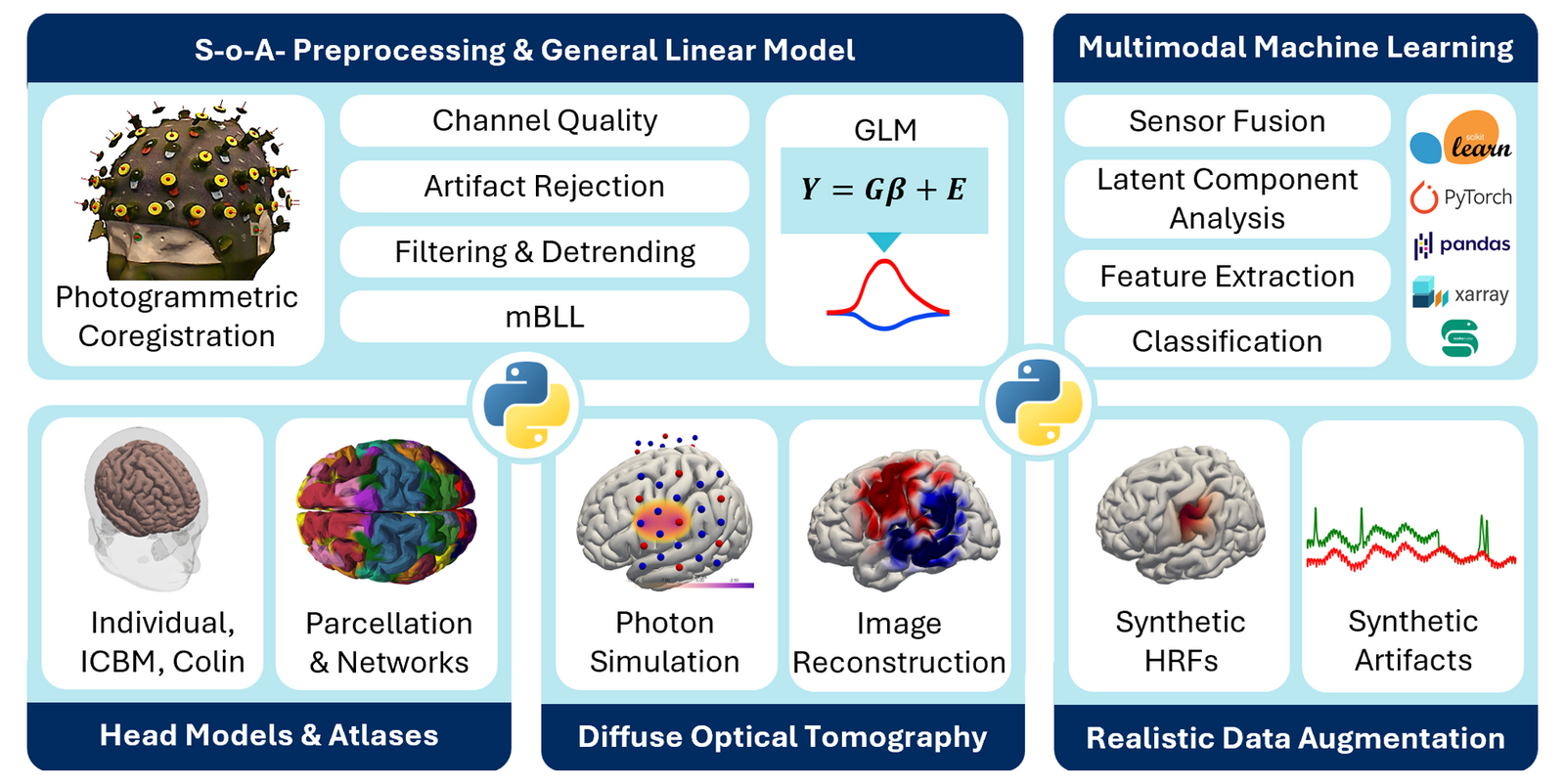
Join us for a 1.5-day workshop on Cedalion, a Python-based toolbox designed for advanced multimodal fNIRS and DOT analysis that can be collaboratively expanded by the community. Following Cedalion’s main release in 2026, the workshop will familiarize researchers with the foundations of the toolbox. Cedalion integrates and expands core features of HOMER3 and AtlasViewer's processing and image reconstruction while tapping into the rich Python ecosystem of modern tools for data analysis and machine learning. At the beginning of the workshop, a hands-on introduction to fNIRS measurements is provided by NIRx Medical Technologies.
- Date: August 24. & 25., 2026
- Venue: Hybrid (Virtual & onsite). Onsite: BIFOLD / Technische Universität Berlin, Franklin Str. 28/29, 7th Floor, Room 701.
- Registration: via Congeno-Form
At the end of the workshop, participants will have learned:
- Foundations of fNIRS acquisition and experiments
- How to use Cedalion for state-of-the-art channel- and image space analysis, preprocessing, regression-based GLM analysis, head models, photon simulation and image reconstruction, photogrammetric probe co-registration, and how to employ Cedalion’s support of machine learning methods for multimodal analysis and classification of fNIRS signals.
Proposed course Schedule
Time zone in CEST. May be subject to change
| Time | Aug 24th | Aug 25th |
|---|---|---|
| Day 1: Foundations & Channel Space Analysis | Day 2: Image Space & Machine Learning | |
| 08:00 | Arrival & Set Up | Arrival & Set Up |
| 08:30 | Welcome & Workshop Orientation | Head Models, Photon Simulation & DOT Image Reconstruction |
| 08:45 | Introduction to fNIRS: Theory and Hands-On | |
| 10:10 | Coffee Break | Coffee break |
| 10:30 | Installation, Data I/O, Core Data Structures | Advanced multimodal Analysis & Machine Learning |
| 11:15 | Basic Preprocessing | |
| 12:30 | Lunch | END |
| 13:30 | Quality Assessment & Motion Correction | |
| 14:30 | General Linear Model (GLM) | |
| 15:30 | Coffee Break | |
| 16:00 | Processing Pipelines & HomerGUI | |
| 17:30 | END |
Registration
Two participation modes are offered: in-person and virtual.
Cedalion Workshop Registration
In-person attendance
- Limited to 35 seats; Seats are assigned first-come, first-served.
- A seat is confirmed only after:
- registering for an in-person slot, and
- paying a €50 fully refundable commitment deposit. Alternatively, seats can be confirmed with proof of booked travel documents.
- The €50 deposit is refunded in full on the first day of the workshop upon on-site check-in.
- Registration without payment does not reserve a seat.
- After the 35 seats are confirmed
- In-person registration closes and no further deposits are accepted.
- Additional registrants are placed on a waiting list without deposit.
- If a confirmed in-person participant cancels, a waiting-list participant may be offered the seat on short notice, otherwise they can attend virtually.
Virtual attendance
- Open to all participants.
- No capacity limit, no deposit required.
- No on-site support and Q&A
Administrative matters
Target attendees
Participants are expected to have basic knowledge in Python. Foundational or advanced knowledge of fNIRS and fNIRS analysis is not necessary but can be a plus.
Hard/Software Requirements for attendees
Participants should bring their own laptops with a running Python installation on their machine. Cedalion is distributed under a permissive MIT license, and no paid licenses are required to take part. Participants are encouraged to install the Cedalion toolbox before the workshop (instructions will be provided 2 weeks prior). Participants are welcome to bring their own fNIRS dataset for experimenting with the toolbox (SNIRF data format required); example datasets are also provided.
Recommended Reading
- Cedalion tutorial paper: https://arxiv.org/abs/2601.05923
- And familiarize with resources on www.cedalion.tools
MoBI2026
- Cedalion workshop can be attended as MoBI2026 pre-conference workshop, and independently.
Workshop Organizers

Alexander von Lühmann
TU Berlin – BIFOLD, Germany
Lead host

Eike Middell
TU Berlin – BIFOLD, Germany

Tomas Codina
TU Berlin – BIFOLD, Germany
Laura Carlton
Boston University, USA

Shannon Kelley
Boston University, USA

Giovanni Hering
NIRx Medical Technologies, Germany
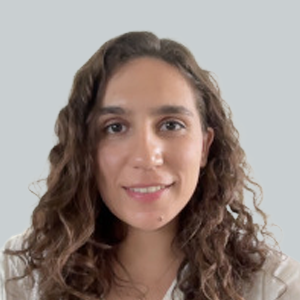
Shakiba Moradi
TU Berlin – BIFOLD, Germany

David Boas
Boston University, USA
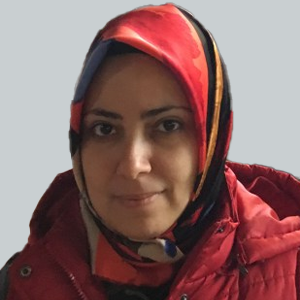
Meryem Yücel
Boston University, USA

Partners