


"Corals"
A kinetic sonic sculpture by Marco Barotti
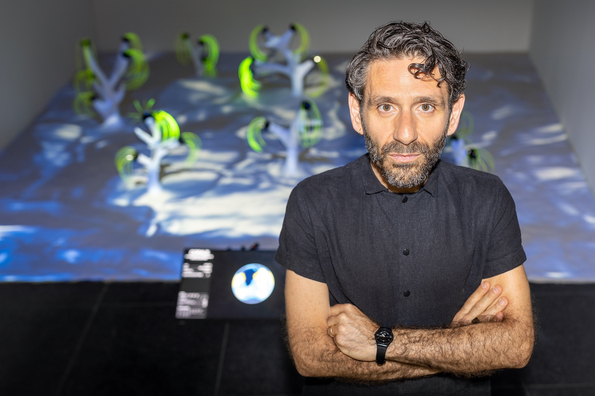
The Berlin-based Italian media artist Marco Barotti is artist in residence of the "Art of Entanglement" program 2022/2023
"I like to work conceptually, and I set out to design one new installation every year," Marco Barotti explains. "My choice of themes is based on purely subjective criteria. All the impressions, ideas and experiences of a year merge at some point into the idea of a particular species from the animal or plant world. This species then becomes my actual subject." His preoccupation with air led to the installation MOSS. To illustrate the unchecked growth of the world's population, he created a giant egg that grows or shrinks in proportion to the growth rate of humanity.
"For the BIFOLD-residency, I am exploring the extremely sensitive ecosystem of corals. The installation CORALS offers insights into the precarious situation of coral reefs worldwide and the complex scientific research on it."
Marco Barotti's work is brought to life through data. He reads data sets from various sensors or databases, interprets or modulates them, and finally uses the result to set parts of his installations in motion, create sounds, or control lighting effects.
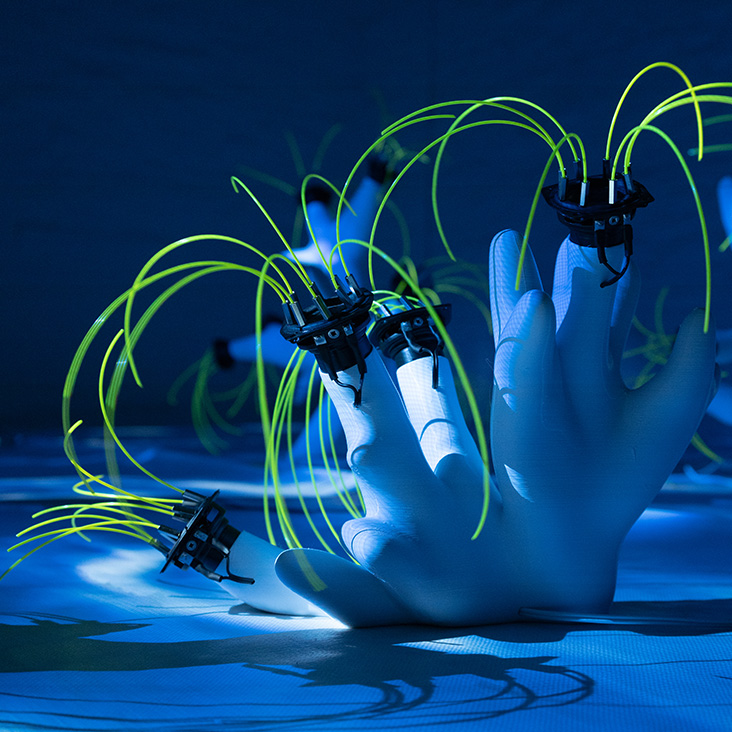
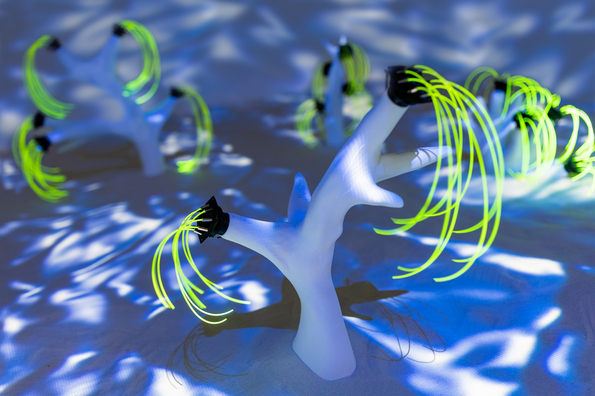
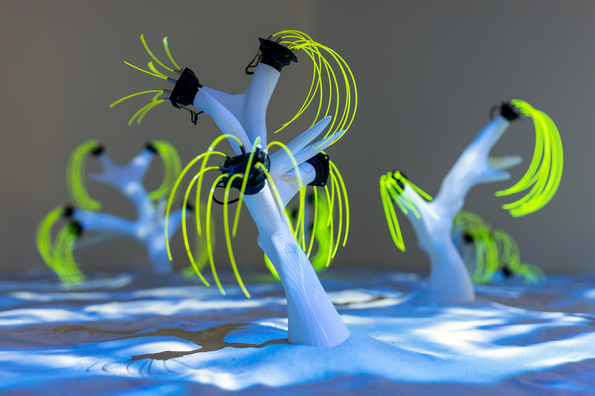
CORALS consists of various white objects, about 60 cm high, standing on a sandy floor. They were designed on the model of branched stone corals. Marco Barotti used precise scientific models of these corals provided by the Earth Observatory of Singapore and reproduced them in a 3D printer. The ends of the coral branches are studded with tiny black speakers from which long, flexible, neon yellow filaments protrude. These artificial polyps are set in motion by the vibrations of the speaker membranes. Their up-and-down movement is reminiscent of sea anemones floating in the current.
The audio elements used combine the sounds of healthy coral reefs with recordings of shamanistic music from around the world, transforming CORALS into a so-called "Techno-Shaman." The shamanistic music ranges from healing rituals to chants to the oceans and death rituals. CORALS is controlled by various software elements: A monitor visualizes the different coral reef zones of the earth with a focus on the so-called Coral Bleaching Alert Areas. In these marine areas, an exceptionally high thermal stress of the corals is measurable, which is classified into five levels. These levels range from "no thermal stress" to "widespread bleaching."
The software randomly selects a geographic location at a time between now and about 20 years ago and evaluates certain environmental parameters. The data comprise sea surface temperatures, anomalies, waves, currents, and biological data. Depending on the degree of coral bleaching at the selected site, machine learning models create the specific "atmosphere" of the installation. The artist developed these special machine learning models, which transform data into sound, light, and movement, in collaboration with BIFOLD scientists. Waves, currents, and sea surface temperature modulate the dynamics and pitch of the sound, movements of the sculptures, dynamics in the lighting systems, and visuals. The biological data interact with various sound effects which enhance the evolving soundscapes and create more variations within the sonic experience.
Machine Learning converts data into light, motion, and sound
In addition to the BIFOLD scientists*, Marco Barotti collaborated extensively with the National Oceanic and Atmospheric Administration (NOAA), a weather and oceanographic agency of the United States, as well as the National Aeronautics and Space Administration (NASA), the U.S. civilian federal space and flight science agency, and Copernicus, an Earth observation program of the European Commission and the European Space Agency (ESA). They all use satellites to continuously monitor the state of the oceans and reefs. The installation challenges the habits of reception in the form of a mystical, dystopian sound collage. Quite remotely, the entire installation is reminiscent of a virtual Geiger counter that makes the threat to a species audible. "CORALS is not static, but 'work in progress' - it will constantly grow and integrate further data, such as new climate and reef data or new shamanistic chants," Marco Barotti explains.
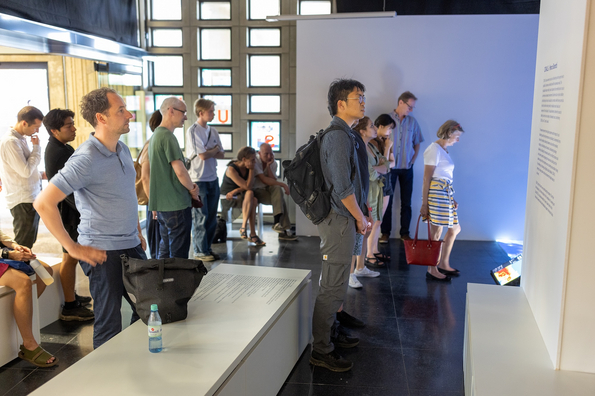
From Berlin, the installation traveled around the world: Berlin, South Korea, and Japan were the first stops where an interested public dived into the threatened underwater world of corals - supported by Artificial Intelligence and without any diving equipment or previous scientific knowledge.
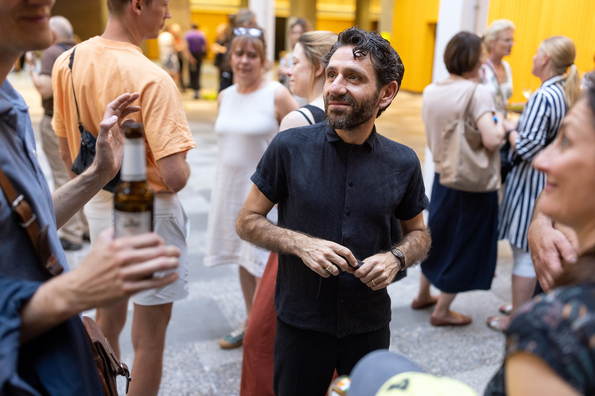
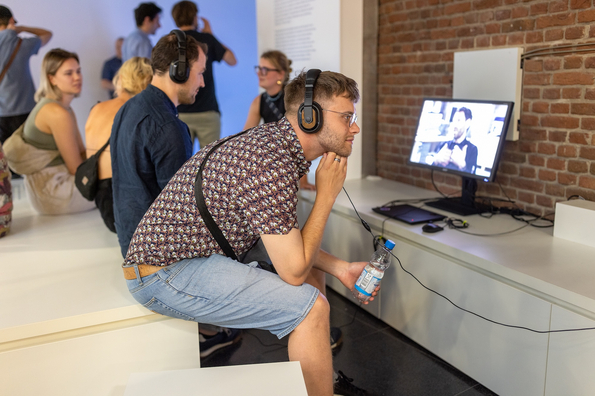
Photo Recap
Learn more about the production of "Corals"
Corals, Part 1
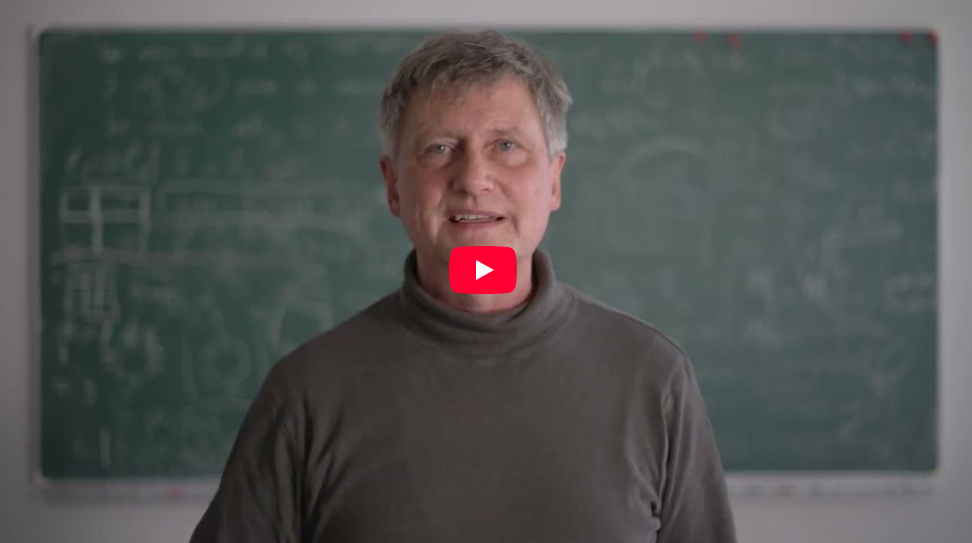
Prof. Dr. Klaus-Robert Müller, BIFOLD Co-director explains why BIFOLD promotes exchange with the arts through its own program.
Watch the video on YouTube
Corals, Part 2
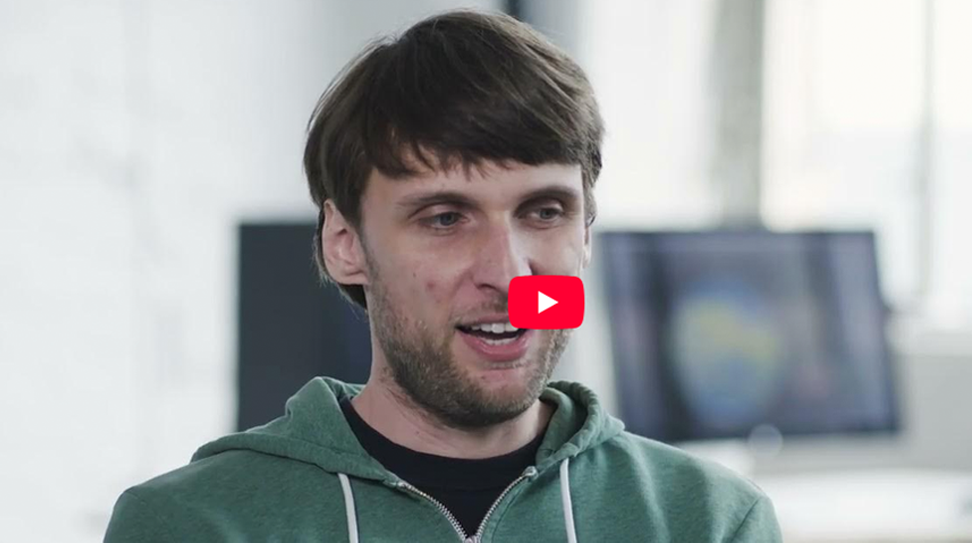
Barotti's data-driven sculptures intertwine human activity, technological development, climate change, and marine pollution.
Watch the video on YouTube
Corals, Part 3
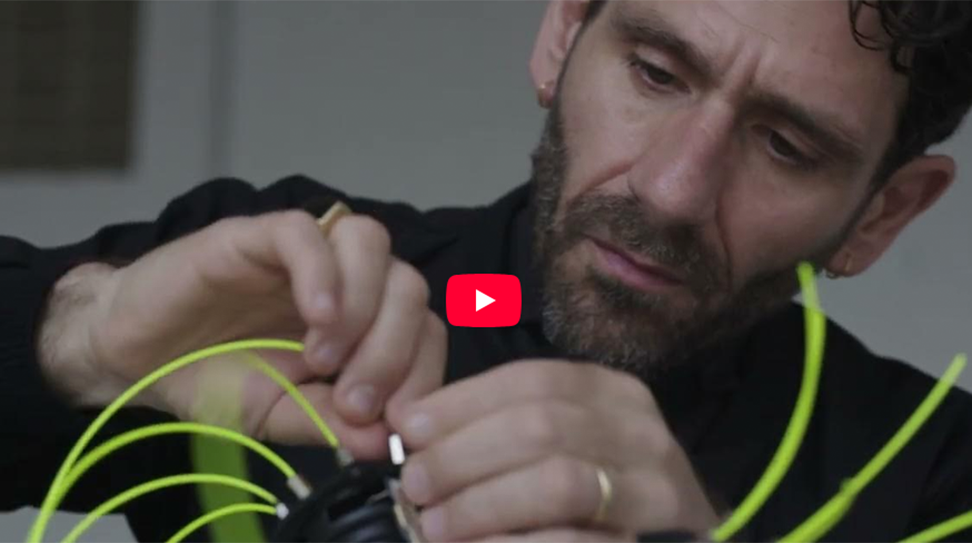
CORALS offers insights into the precarious state of coral reefs worldwide and the complex scientific research behind their restoration.
Watch the video on YouTube