





Seeing enough without seeing everything: A BIFOLD researcher on scalable, privacy-aware data processing.
Data protection rules exist to protect people, not to freeze the systems built to enforce them. Yet most privacy protection systems perform worse the more data they must protect. Dr.-Ing. Rudi Poepsel Lemaitre, who defended his PhD summa cum laude at BIFOLD and TU Berlin's Database Systems and Information Management group in May 2026, spent his doctorate proving it doesn't have to be that way, building databases that reveal only as much as they must, and stay fast while doing it.
An engineer's son who traded machines for algorithms
Poepsel Lemaitre comes from a family of engineers in Bolivia and was expected to become one himself, until a single programming course rerouted him toward computer science and, eventually, to TU Berlin's DIMA group in 2016. The moment that actually set his research direction, though, came in a lecture by Prof. Dr. Volker Markl on the Count-Min Sketch, a memory-efficient data structure that estimates how often items occur in large data streams.
I found it super elegant that you can use complex mathematics to make things so much more efficient, while only giving up a little bit of accuracy.
That trade-off, a small accuracy loss for a large efficiency gain, became the thread running through his entire PhD, most of it proven on synthetic data he could grow into the billions to show that a method scales in principle. His first attempt to test it against the real world was a Software Campus project with the publisher Holtzbrinck. The difficulties he experienced in this project taught him a hard lesson, but one that still paid off: the program's seminars introduced him to project management and leadership - something he wouldn't have picked up in the lab; he calls it a big help early in his PhD, and remains an active member of the Software Campus alumni network today.
Two ways to protect data at scale, without slowing the systems down
Poepsel Lemaitre's dissertation, “Towards Scalable Compliant Data Processing Using Data Masking and Summarization,” tackles a problem that worsens as a database grows: privacy protection typically slows the underlying queries and systems as data volume climbs into the millions or billions of records. His answer works in two directions.
Summarization: Instead of accessing raw sensitive data, the system can keep compact summaries that can answer important questions efficiently. Poepsel Lemaitre’s proposed framework, “Condor,” facilitates using data summaries in stream processing and enables them to fully utilize available system resources. The approach provides mathematical guarantees on result accuracy, while stronger privacy guarantees can be incorporated when needed.

Dr. Rudi Poepsel Lemaitre is devoted to his family and to Bolivia. Every system he builds carries a Bolivian name. He earned his PhD summa cum laude in May 2026 in TU Berlin's DIMA group and BIFOLD, supervised by Prof. Dr. Volker Markl. His thesis addresses a key problem in modern data protection: how to keep privacy solutions working well at large real-world scale. He is passionate about football and chess. He plays soccer for the Galileo Goalgetters team and calls his father in Bolivia every week to watch Real Madrid together over the phone. His favorite chess opening is the Sicilian Defense, which he always used to play against his grandpa.
Data Masking: The second approach changes how privacy rules are implemented. Instead of engineers manually coding every possible scenario, a data protection officer can specify what different users are allowed to see, and the system enforces those rules. For example, in a database containing medical data, a clinician might see a patient’s exact age, while a researcher might see only an age range such as fifteen to twenty. The database automatically chooses the least restrictive masking that still meets the privacy requirements, preserving as much useful information as possible.
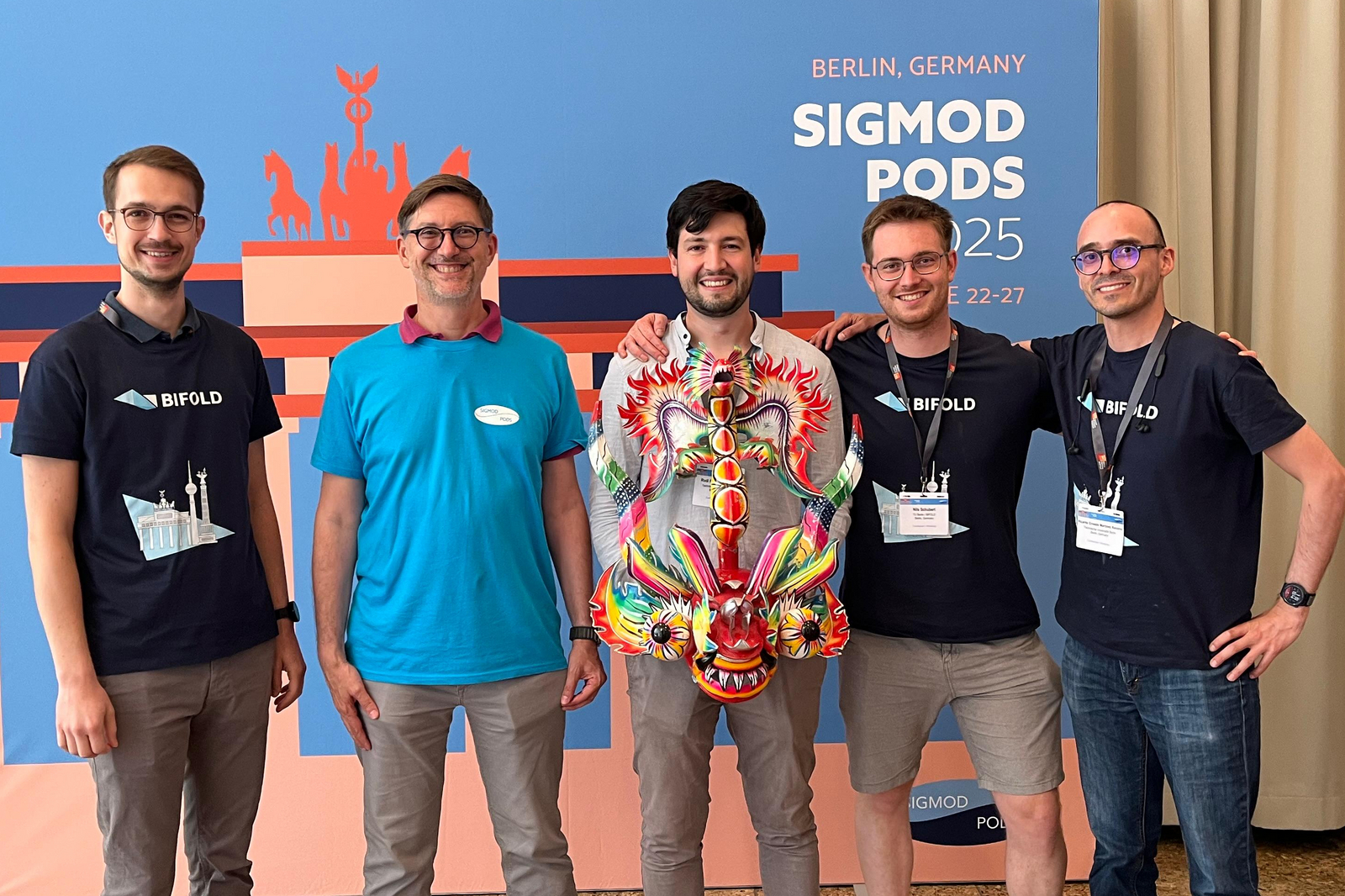
That masking idea became “Mascara”, presented at SIGMOD 2024 as “Disclosure-compliant Query Answering.” For his talk, Poepsel Lemaitre borrowed a historical huge ceremonial mask from the Bolivian Embassy in Berlin, after the ambassador insisted he take the largest one in the collection.
Differential privacy is going to be the future of how we protect data
Poepsel Lemaitre expects data collection to keep accelerating, raising the stakes for getting protection right, and for formalizing what regulations like the GDPR actually require in mathematical terms. He points to differential privacy as the framework the field is converging on. Differential privacy is a mathematical framework that provides strong guarantees of how secure your data is. Rudi thinks it will remain the future of how we protect data.
Dog tales
Midway through his PhD, Poepsel Lemaitre adopted Laika, a Jack Russell Terrier whose previous owner had called her hopeless and uneducable. She wasn't. Together with his wife, Laika helped Rudi to find some mental balance while pursuing a PhD. The dog made it clear: solutions come from consistency, a lesson that proved also true for his thesis.
Declarative Data Masking lets organizations define privacy rules, such as which roles may see which level of detail, without implementing the underlying protection mechanism themselves. A database system automatically selects and applies the masking strategy that best satisfies these rules while maximizing the usefulness of the resulting data, balancing regulatory compliance (e.g., GDPR) with real-world utility.
In the near future, Rudi is heading into industry, without ruling out a return to academia. For him, it doesn't feel right to make a career decision without knowing what the other side looks like. Wherever that path leads, his projects will likely carry a Bolivian name to honor his family.
--
Snapshots


Three key works by Dr.-Ing. Rudi Poepsel Lemaitre
Disclosure-Compliant Query Answering (Mascara): Proceedings of the ACM on Management of Data (PACMMOD), Vol. 2, Issue 6, 2024 (SIGMOD 2024). Introduces Mascara, a system for declarative, disclosure-compliant query answering that dynamically adapts data masking to query semantics while minimizing information loss.
In the Land of Data Streams where Synopses are Missing, One Framework to Bring Them All (Condor): Proceedings of the VLDB Endowment (PVLDB), Vol. 14, Issue 10, 2021. Introduces Condor, a framework that makes data synopses first-class operators in streaming systems, hiding the complexity of distributed processing while enabling high-performance, scalable approximate analytics.
Pacha Sketches: Organizing Multidimensional Space for Efficient Aggregation. Under submission. Introduces Pacha Sketches, a scalable summarization technique that enables efficient and accurate aggregate queries over high-dimensional data, without requiring repeated access to the underlying raw data.