





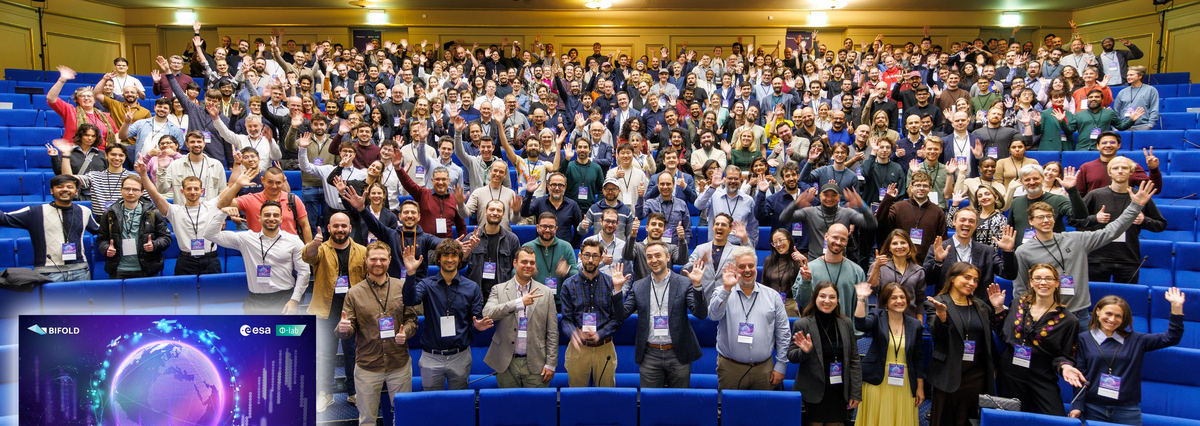
The first edition of the ‘Agentic AI for Earth Observation’ workshop explored how Earth observation data and products can boost agentic AI decision intelligence systems and how agentic AI could transform the way Earth observation data are accessed, analysed and used. Bringing together more than 500 attendees, the event highlighted the field’s rapid move towards practical applications, while emphasising the still open scientific questions, the need for human oversight, trusted ecosystems and solutions that deliver measurable value for the society.
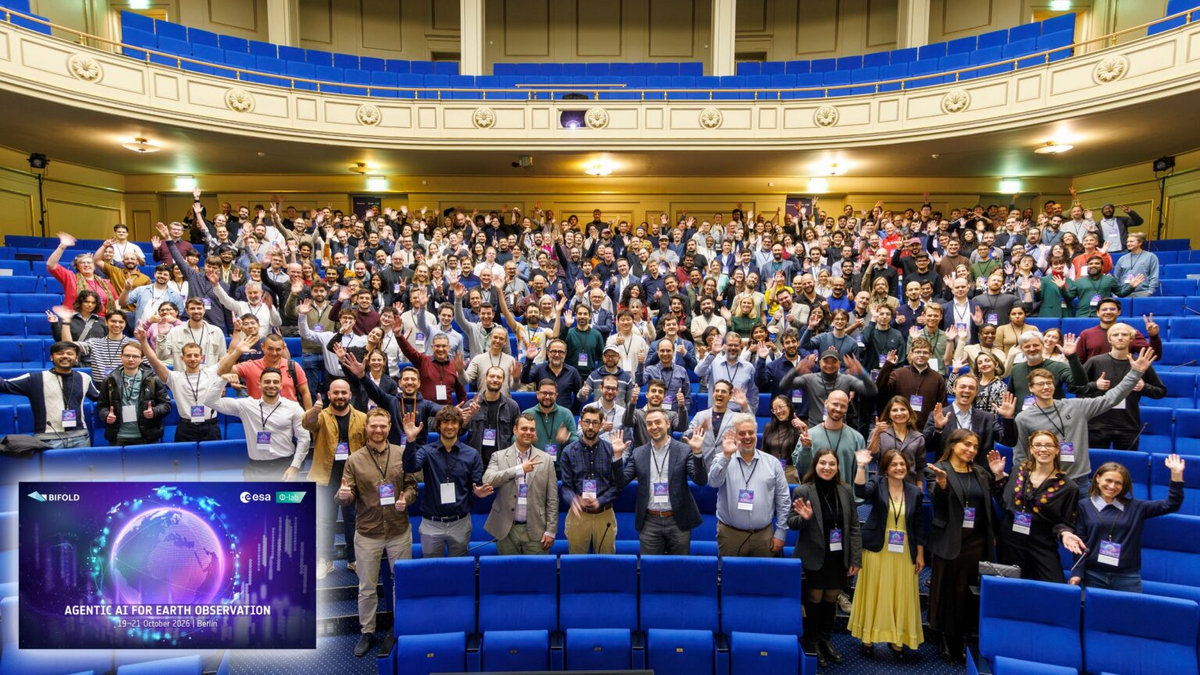
Held in Berlin (Germany) from 19 to 21 October, the inaugural ‘Agentic AI for Earth Observation’ workshop brought together more than 500 researchers, practitioners, end users and decision-makers from artificial intelligence, geospatial analytics, climate and weather science, remote sensing and space mission.
Organised by ESA Φ-lab and the Berlin Institute for the Foundations of Learning and Data (BIFOLD), this workshop promoted exchanges between academia and the industry. Participants explored cutting-edge research, practical challenges and emerging opportunities, with a focus on how autonomous agents could transform the way geospatial and satellite data are acquired, processed and used.
In addition, the workshop also highlighted how Earth observation can provide the observations and geospatial context needed by agentic AI to support decision intelligence.
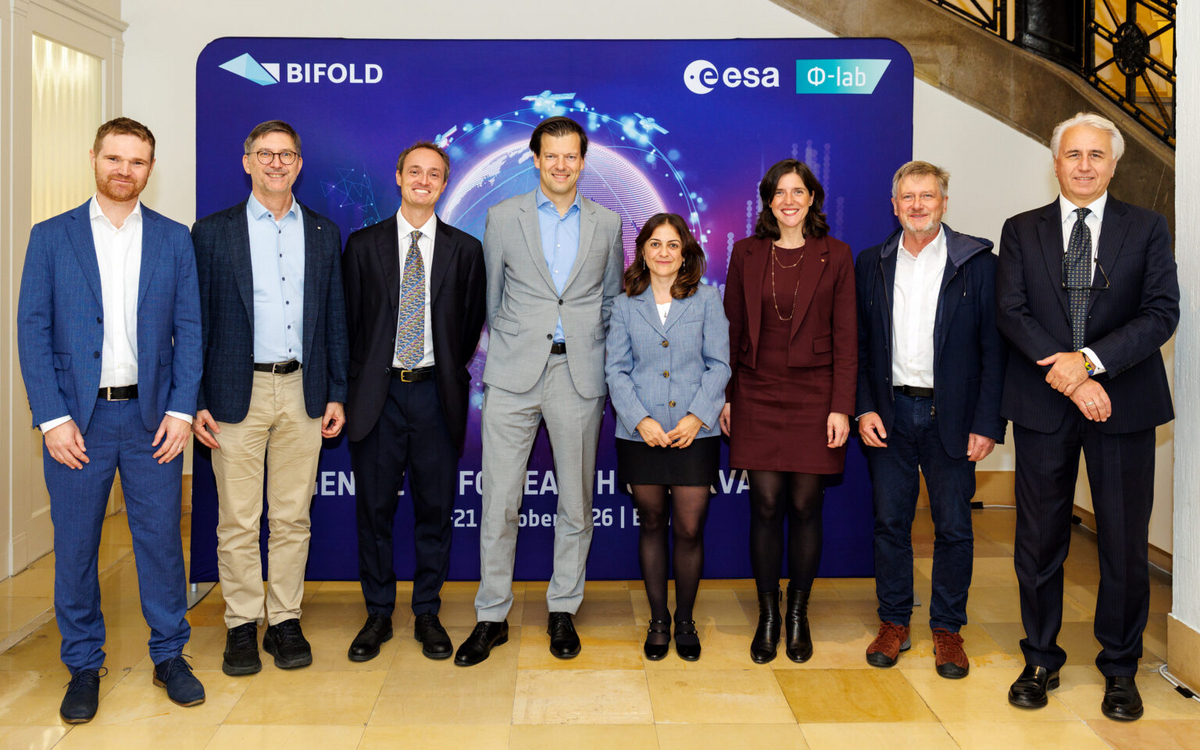
The strong turnout highlighted the momentum around this topic. Here are five takeaways from the event:
Agentic AI for Earth observation is moving from exploration to practice
Earth observation is rapidly moving beyond individual workflows towards connected systems that are increasingly autonomous and capable of handling complex tasks. Combining Earth observation data with geospatial foundation models, large language models, AI agents and specialised tools allows for deeper analysis and longer workflows.
Earth observation specialisation remains essential: models and agents designed for the sector can perform better on specialised tasks than general-purpose solutions.
The workshop also showed that agentic AI is already moving into practice, with many working prototypes available for users to explore and test, namely in utility/infrastructure monitoring, semantic object discovery without labels, crop/vegetation inspection, satellite image discovery using natural language, and Earth observation image retrieval and similarity search.
We need the ‘right’ autonomy, not the maximum autonomy
The aim of agentic Earth observation systems is not autonomy for its own sake, but to delegate decisions to agents where autonomous action brings value, while retaining human oversight, rigorous scientific evaluation, and system-level constraints where needed.
Autonomous systems must also know when to complete a task, use a tool, delegate a task to another agent or stop the task entirely. More agents and tool calls do not necessarily produce better results.
As these systems become more complex, ensuring that their workflows are transparent and reproducible, according to the FAIR (Findable, Accessible, Interoperable and Reusable) framework, is an emerging challenge. Provenance and scientific scrutiny must therefore cover the entire workflow, from the original data to the result.
Agentic Earth observation requires ecosystem-level trust and technological sovereignty
Agentic Earth observation is evolving from individual agents towards distributed systems in which multiple agents work together. This requires agents to be discoverable by other agents and orchestration systems, interoperable, and reusable across platforms and organisations.
Increasing trust in these agents will require clear safeguards for identity, data provenance, permissions and accountability. As with AI in general, technological sovereignty is also an important consideration, spanning data, infrastructure, algorithms and models. In agentic systems, this extends to the services, tools and external agents on which they may depend. For Europe, this means identifying and addressing dependencies and vulnerabilities within agentic systems.
Bringing real value to society is what matters most
Agentic AI could make Earth observation more accessible by enabling users to formulate objectives rather than manually defining every step of an Earth observation workflow. Agents could discover relevant observations, select appropriate processing and analytical tools, coordinate their execution, and translate the resulting information into actionable insights. This could strengthen the integration of Earth observation into domains such as disaster management, climate resilience, insurance, environmental monitoring and scientific research.
Such agent-driven workflows should remain transparent, traceable and scientifically robust, particularly when their outputs inform decisions. The success of an agentic system should not be measured by the number of agents or tool calls, or by the level of autonomy achieved. What really matters is building trusted, scientifically grounded systems that can deliver measurable value for users, science and society.
The future lies in building the next generation of Earth Intelligence
The next step is to move beyond individual proofs-of-concept and develop shared frameworks that can support agentic AI for Earth observation in real-world operations. This will require community benchmarks to assess whether agents are trustworthy, scientifically sound and ready for practical use. It will also mean connecting data, models, tools, computing resources and space- and ground-based assets more effectively.
Throughout the development of these systems, it will be important to distinguish emerging research from demonstrated capabilities and operational or commercial solutions. Human oversight and Earth observation expertise must remain at the heart of every workflow.
In the end, the goal is to create a new generation of Earth Intelligence systems that can observe, understand, decide and act, while operating within clearly defined constraints and accepted levels of risk.
Claudio Iacopino, Head of the ESA Φ-lab Explore Office, reflected on the outcomes of the workshop: “Agentic AI has great potential to make Earth observation more accessible and useful, and this workshop provided insights that will help us move towards real-world adoption. But we need to keep in mind that the autonomy of these systems must go hand in hand with human oversight and scientific validation. Our goal is not simply to build more capable systems, but actually create trusted tools that deliver meaningful benefits for society.”
Begüm Demir, BIFOLD Deputy Director and Professor at the Technical University of Berlin, said: “The goal of this workshop was to strengthen the community’s skills and expertise in the design and development of efficient, effective, and trustworthy AI agents for Earth observation. The lively discussions and tremendous interest from participants showed us that we had achieved this goal. We are delighted with the outcome.”
To know more: Agentic AI for Earth Observation workshop, ESA Φ-lab, Berlin Institute for the Foundations of Learning and Data (BIFOLD)
Photo courtesy of BIFOLD/Michael Setzpfandt.
Original news (ESA)