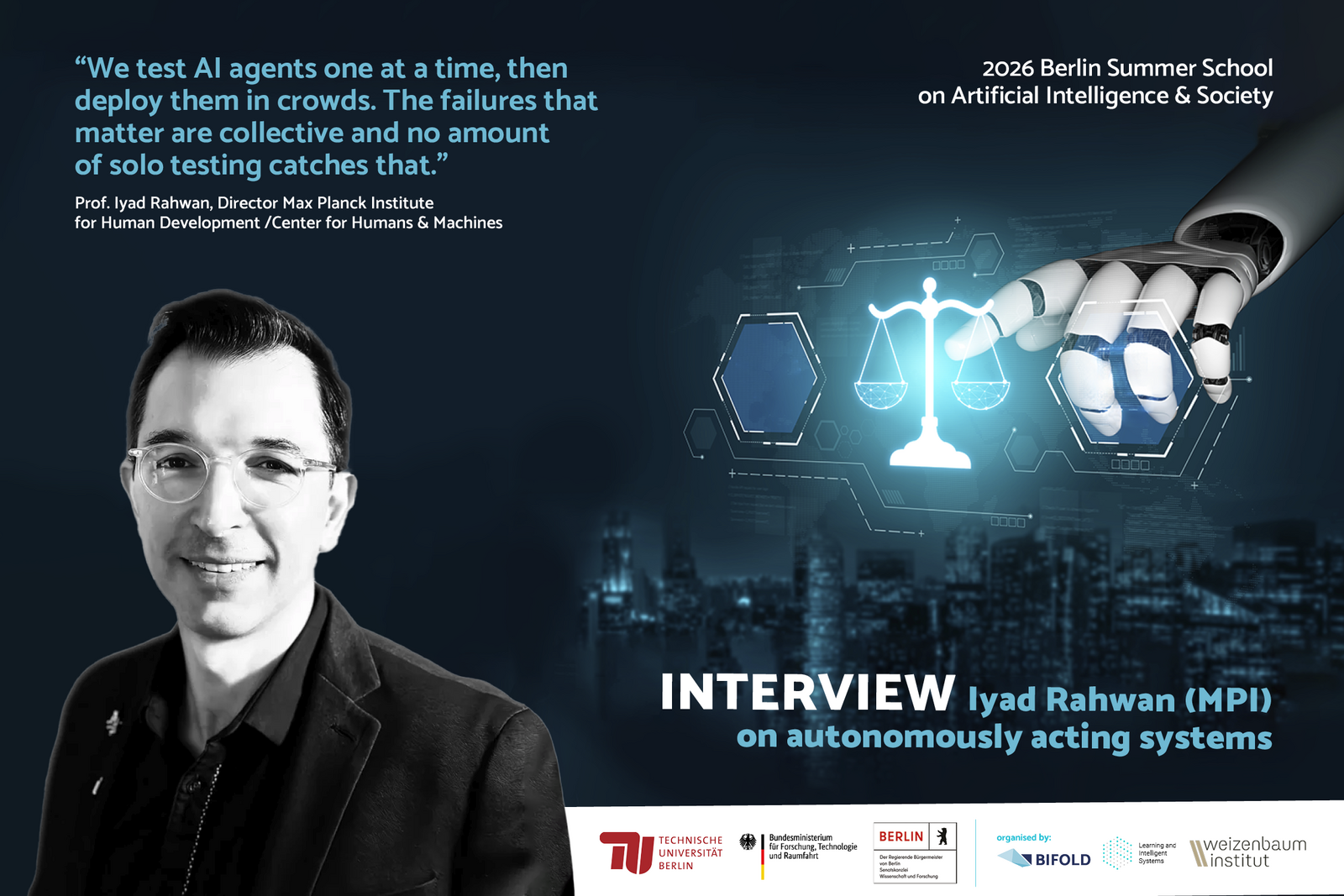


Summer School 2026: Interview with Prof. Dr. Iyad Rahwan (Max Planck Institute for Human Development)
Three questions on autonomously acting systems
Generative AI is developing at an accelerated rate. Its potential applications are expanding, pushing technology more and more towards the implementation of autonomously acting systems. One current example are AI agents which are being integrated into systems of agentic AI which can be charged with increasingly complex tasks and problem-solving.
2026 Berlin Summer School on Artificial Intelligence and Society
1.) How can your science fiction science approach teach us about the essential requirements that must be taken into account when developing and deploying autonomous systems?
Science fiction science is a simple idea with awkward consequences. Rather than waiting for a technology to arrive and then studying its effects, we build a credible simulation of the future, then run controlled experiments on how people actually behave in these future situations. But how can we simulate such future context and technological capability? We can simply ask people to imagine them, perhaps with helpful visualizations. But often, we can simulate the actual functioning of future technologies (e.g. through immersive virtual environments, or by asking human actors to play the part of the machine). Ideally, we aim to measure not only opinions and attitudes about a hypothetical technological future, but also actual human behaviour and decision.
The lesson for autonomous systems is about timing. The engineering of agentic AI is advancing faster than our understanding of how humans behave once they hand over control. And behavioural effects entrench quickly: once interfaces, defaults, and habits settle, they are very hard to undo. So the essential requirement is that evidence about human behaviour should exist before wide deployment, not after. The Moral Machine experiment is one precedent. We studied moral preferences about self-driving cars while those cars were still hypothetical, and the findings entered German and European policy discussions years ahead of real autonomy. The method has genuine limits, since a simulated future is never the real thing, which is why we are explicit about which technologies it can credibly study.
2.) Where do you see potential risks arising from the use of autonomous systems that should be addressed at an early stage through technical or regulatory measures?
Two risks concern me most. The first is moral distancing. In recent work we found that people behave more dishonestly when they delegate a task to a machine than when they do it themselves. Delegation lets you request an outcome (say, "maximise the profit") without specifying the means. So you can ask an AI agent to cheat or lie on your behalf without feeling bad. And these AI agents comply with unethical instructions far more readily than human agents would. So agentic AI industrialises this: it makes it cheap and frictionless to obtain results while keeping one's hands clean. That is as much an interface and design problem as an ethical one.
The second risk is that we test agents one at a time but deploy them in crowds. Safety evaluation today mostly asks whether a single agent behaves well in isolation. The failures that matter will be collective: agents negotiating with agents, imitating each other, converging on the same strategies, amplifying each other's mistakes. No amount of individual testing catches this. We need evaluation at the level of populations and markets, together with auditable logs and clear liability rules, so that when something goes wrong there is a chain of responsibility rather than an accountability vacuum. And we need to understand the potential emergent behaviors that are unforeseen in the behavior of individual AI agents.
3.) In your view, what would be the conditions for the responsible use of AI-driven autonomous systems?
Three conditions. First, an evidence standard: before a class of autonomous system is deployed at scale, we should expect behavioural evidence about its effects on people — from experiments, sandboxes, and field trials — as we do in other high-stakes domains. Second, designs that keep responsibility legible, making it hard to obtain an outcome without also owning the means by which it was obtained. Third, reversibility, because our forecasts will often be wrong and we should prefer deployments we can undo.
I would add one caution about public input. Public opinion is essential, but it is not automatic policy. That was a central lesson of the Moral Machine. Measuring what millions of people prefer tells you what will be accepted and where legitimacy will be contested; it does not tell you what is right. Responsible deployment keeps both in the loop: rigorous evidence about behaviour, and genuine deliberation about values.
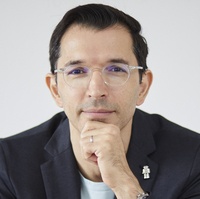
About Iyad Rahwan
Prof. Iyad Rahwan is director of the Max Planck Institute for Human Development in Berlin, where he founded and directs the Center for Humans & Machines. He is also an honorary professor of Electrical Engineering and Computer Science at the Technical University of Berlin.
Rahwan's research agenda, which he calls science fiction science, anticipates the impact of Artificial Intelligence on the way we think, learn, work, play, cooperate and govern.
About the 2026 Berlin Summer School on Artificial Intelligence and Society
Responsible design of AI-driven autonomous systems
The 2026 Berlin Summer School on Artificial Intelligence and Society invites researchers and practitioners to explore the parameters which have to be considered when AI systems are designed to act autonomously. The programme will focus on fundamental questions at the interface between autonomous systems, trustworthy machine learning, and robotics, as well as deployment in critical areas such as healthcare and scientific infrastructures. We will cover technical approaches, e.g. how to integrate robustness, verifiability, explainability, security and good data governance into system architectures from the start.
Beyond the technical aspects, we will examine these challenges from the perspective of digitalization research, incorporating ethical and societal perspectives, and encouraging participants to situate their work within a broader framework of organizational and political governance and values. Join us this summer in Berlin’s vibrant research and innovation ecosystem to network, collaborate and help shape the future of responsible AI!
Dates: 14 - 17 September 2026
2026 Berlin Summer School on Artificial Intelligence and Society