



Proteomics at the Frontier: Python Hearts, Tumour Maps and Better Blood Tests

September
02,
2026  18:30
- 21:00
18:30
- 21:00


Proteomics at the Frontier: Python Hearts, Tumour Maps and Better Blood Tests
Abstract
If you want to watch biology in motion, watch the proteome: it shifts with disease, treatment, and time. Mass spectrometry provides a window onto this moving picture, which is getting dramatically better right now: new instruments quantify thousands of proteins in minutes, not hours, making population-scale and even routine clinical proteomics realistic for the first time, opening up new opportunities for drug discovery, therapy and diagnostics. With this event we bring together three perspectives from the frontier:
The heart that rebuilds itself — Dr. Lorena Suarez, Postdoc at the Proteomics Platform, Max-Delbrück-Center Berlin
After a large meal, the heart of a Burmese python grows dramatically and then shrinks back, fully reversibly. What can this extreme physiology teach us about how human hearts adapt, and fail to adapt? Lorena Suarez combines functional measurements with proteomics to reveal regulatory mechanisms no single method could see: mechanisms that point towards new angles on cardiac hypertrophy and heart failure, where adaptation goes wrong rather than right.
Mapping the tumour's neighbourhood — Dr. Oliver Klein, Head of the Imaging Mass Spectrometry Unit, Berlin Institute of Health
Ovarian cancer is not one disease but a patchwork and where a cell sits in the tumour matters as much as what it is. Using imaging mass spectrometry and spatial multiomics, Oliver Klein shows how mapping the tumour microenvironment uncovers cell populations linked to treatment response and survival, and why tissue architecture may hold the key to chemoresistance.
Why half of all plasma biomarkers are wrong — Dr. Philipp Geyer, Co-Founder and Managing Director, ions.bio
Plasma is the most attractive material for biomarker discovery and the most treacherous: roughly half of published studies report a "biomarker" that is really a contamination artefact from sample handling. That matters, because these artefacts propagate into validation studies, diagnostics pipelines, and clinical decisions built on sand. Philipp Geyer explains what goes wrong between blood draw and mass spectrometer, and presents a quality-control framework that makes plasma proteomics trustworthy down to the level of individual health profiles.
Agenda
-
18:30 - Doors open
-
19:00 - Talks start
-
20:00 - Drinks and networking
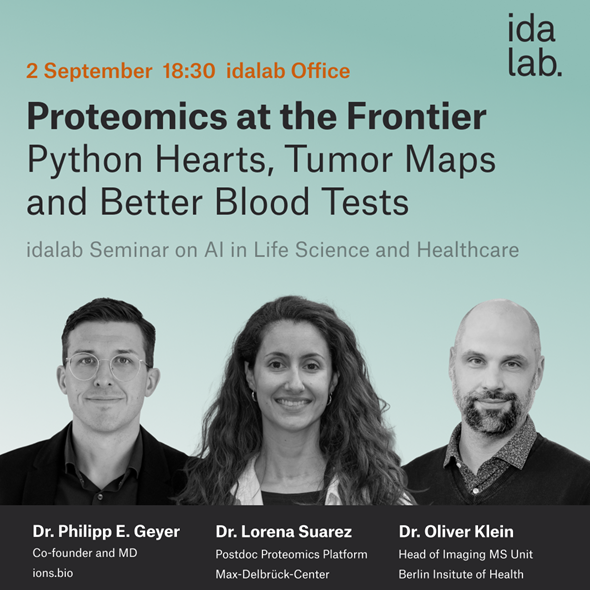
Dr. Lorena Suarez is a postdoctoral researcher at the Proteomics Platform of the Max-Delbrück-Center (MDC), where she studies stretch signalling and mechanotransduction in the heart in collaboration with the Gotthardt Lab. She completed a BIH translational PhD at the MDC and Charité in 2021, following degrees in biology and biomedicine at the University of La Laguna, Tenerife.
Dr. Oliver Klein leads the Imaging Mass Spectrometry Unit at the Berlin Institute of Health (BIH), where he works on several clinically driven projects, and has headed the Proteomics Unit at the BIH Center for Regenerative Therapies since 2009. His doctorate (2015) focused on detecting pathophysiological processes in tissue after cell therapy using mass spectrometry-based proteomics, both imaging MS and LC-MS. He trained in pharmaceutical engineering in Berlin and worked on protein structure elucidation via NMR and mass spectrometry at the Leibniz Institute for Molecular Pharmacology (FMP) before joining the Charité in 2007.
Dr. Philipp E. Geyer is co-founder and managing director of ions.bio GmbH and a member of HUPO's Plasma Proteomics Committee. His research centres on mass spectrometry-based biomarker discovery, with a focus on robust, high-throughput plasma proteomics workflows for health and disease assessment. He previously co-founded OmicEra Diagnostics and served as Director for Proteomics Research at Exact Sciences, and completed his PhD at the Max Planck Institute of Biochemistry and the Novo Nordisk Foundation Center for Protein Research in Copenhagen.