

Fundamental research shaping modern AI
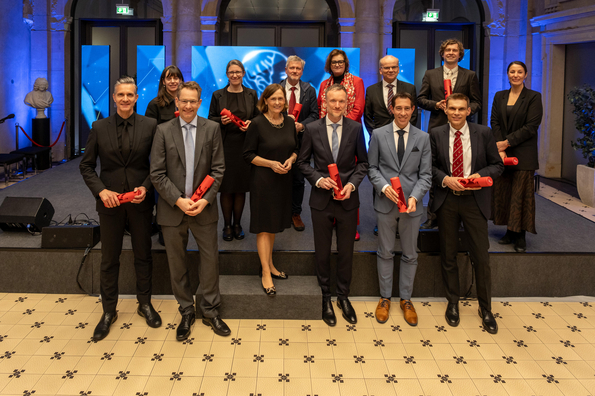
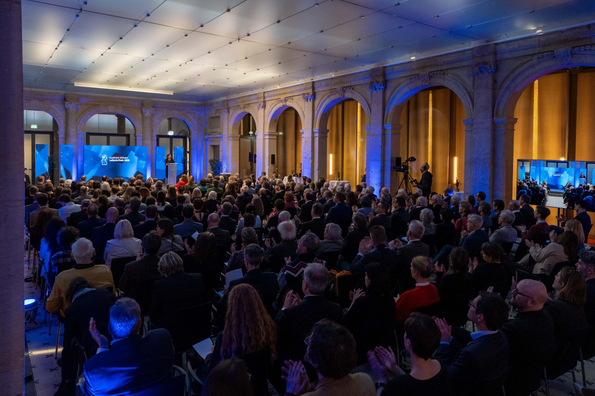
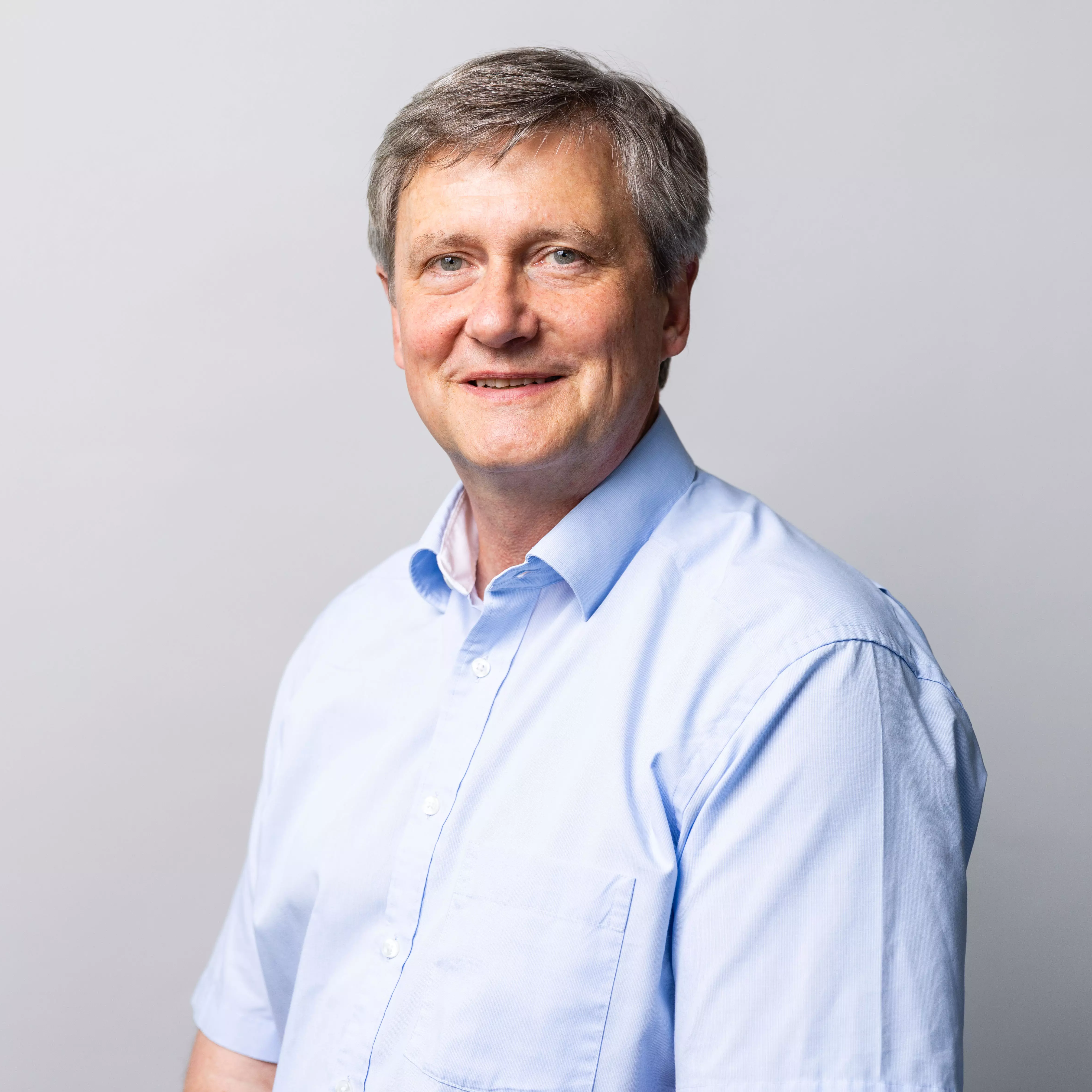
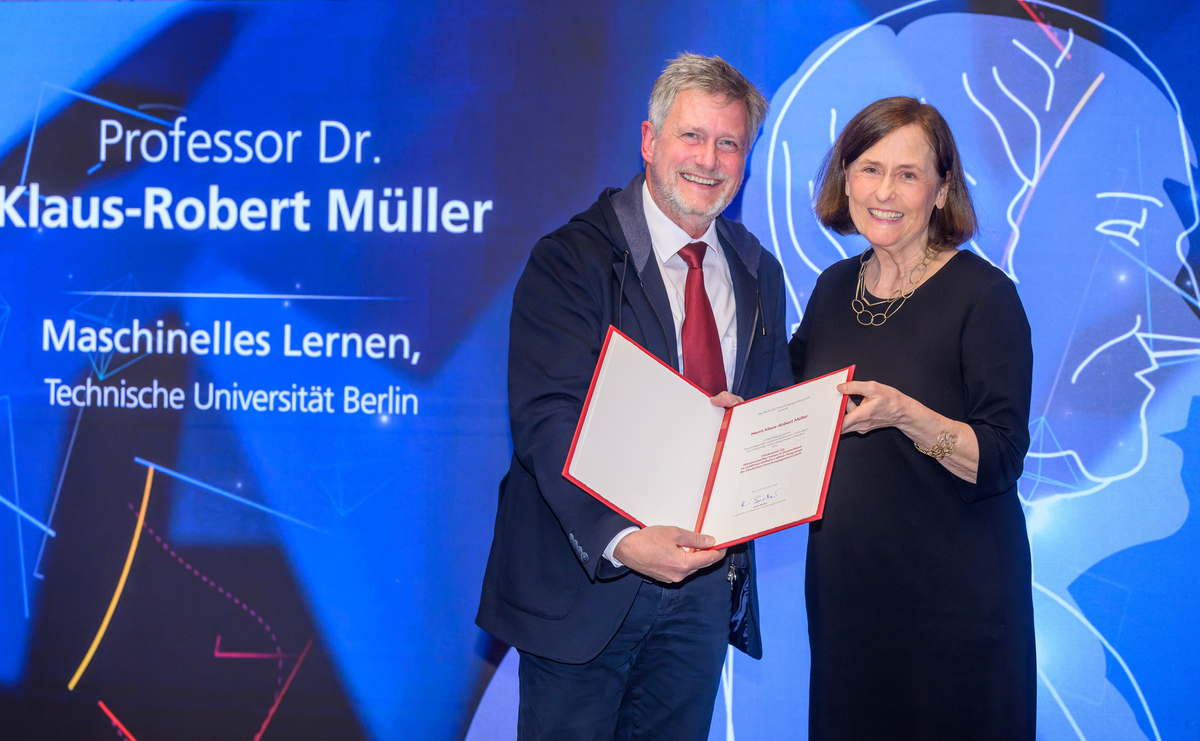
On March 18, 2026, the German Research Foundation (DFG) officially awarded the Gottfried Wilhelm Leibniz Prizes 2026 at the Berlin-Brandenburg Academy of Sciences and Humanities. Among the awardees is Prof. Dr. Klaus-Robert Müller, Professor of Machine Learning at Technical University of Berlin and co-director of BIFOLD. He received Germany’s most prestigious research award, endowed with €2.5 million, in recognition of his decades-long foundational contributions to AI research and its applications in the natural sciences.
The event was opened by DFG President Katja Becker and included remarks by Federal Minister Dorothee Bär as well as Berlin’s Senator for Science Ina Czyborra.
Klaus-Robert Müller is internationally regarded as one of the most influential figures in modern machine learning. In the 1990s, he co-developed the theoretical foundations of support vector machines (SVMs) together with Vladimir Vapnik, a breakthrough that remains one of the most significant advances in the field. His later work on deep neural networks has also had a major impact. More recently, he has focused on explainable artificial intelligence (XAI), a field aimed at making AI systems transparent and interpretable, thereby enabling their use in critical domains such as medicine.
“AI is far richer than just foundation models”
Another focus of his current work is the application of machine learning in the sciences, particularly physics and chemistry. “A trend that particularly interests me is the development of new, specialized foundation models for the sciences. For example, we have developed SO3LR, a foundation model for quantum chemistry, as well as Atlas-2, a foundation model for histopathology. These are important first steps and provide a solid basis for addressing complex scientific questions even when only limited data is available,” Müller explains. “However, one should not focus exclusively on foundation models, AI is far richer than just foundation models.”
“I became a researcher out of a passion for discovery”
He is convinced that the use of AI opens up entirely new and exciting possibilities and will fundamentally transform scientific work. However, he emphasizes: “Young scientists - now as in the past - must learn the mathematical and technical foundations of their field; otherwise, they cannot assess the correctness and quality of AI-generated results.”
It is precisely the reinterpretation or questioning of existing knowledge that drives scientific progress. This is what continues to motivate Klaus-Robert Müller even after more than 38 years in academia: “I became a researcher out of a passion for discovery. That is why I will continue working in my favorite areas - machine learning theory and applications in histopathology and quantum chemistry - for as long as I have questions to explore.”
That this point is not likely to come anytime soon is evident from his recent plans. The interdisciplinary nature of Müller’s research has always been a defining feature. For many years, he has collaborated with major chemical companies as well as with Charité – Universitätsmedizin Berlin.
“I plan to use the prize money in part to connect our AI models for quantum chemistry with real-world experiments, there is still significant research needed in this area. Another highly exciting field is our medical collaborations: my goal is to process multimodal data, such as tissue images, protein expression data, and radiological data, within our histopathological models.”
- Photo film portrait (© DFG)
- Award ceremony stream (March 18, 2026, © DFG)
- Photo download (Award Ceremony for Prof. Dr. Klaus-Robert Müller; © DFG / David Ausserhofer)
- RBB interview with Klaus-Robert Müller (March 18, 2026)
Additional information:
Prof. Klaus-Robert Müller will deliver his Leibniz Lecture at TU Berlin on May 28, 2026.