



Federated Learning, multimodality, foundation models: A BIFOLD researcher is putting modern AI's most powerful tools to work for Earth observation
Satellite data are a key to understanding our planet from a macro perspective. They reveal patterns that remain invisible to the human eye. Optical imagery, radar scans, multispectral measurements, and other data explain to us how the world is changing: how humans are intervening in the environment, how climate change is affecting nature, how cities are developing, and much more.
A large portion of this Earth observation data is captured in low Earth orbit. 160 to 2,000 kilometers above our heads, a small network of satellites collects petabytes of data daily and transmits them to Earth. However, this enormous body of data is distributed across numerous operators and institutions: Big Data, in silos, separated by legal, technical, and organizational barriers. The question, therefore, is how to transform this mountain of data into a treasure trove of data. The answer is well known: with the help of AI, by means of machine learning. What has not yet been fully researched is how to bring together large quantities of Earth observation data across silo boundaries using machine learning. Dr. Barış Büyüktaş, researcher at BIFOLD and member of the Remote Sensing Image Analysis research group, is dedicating himself to precisely this challenge, with the help of federated learning.
If the data isn't allowed to travel, the model travels
The classical approach to analyzing large volumes of data is the "the dog goes to the bone" method. All data sources are copied into a central storage system, for example a cloud bucket like AWS S3, Azure Data Lake, or Snowflake. There, raw data from all kinds of systems sit side by side, and analytics teams or machine learning models access this central copy. The idea: one place, one truth, everything queryable. This works excellently within a single organization, where data is allowed to circulate freely. But it hits hard limits as soon as multiple institutions, countries, or legal jurisdictions are involved.
Federated learning breaks through these limits. It is the "bone-comes-to-the-dog" approach. The method was introduced by Google in 2016 to tackle the challenge of training AI models without centrally collecting sensitive user data. This technology accompanies us in everyday life today, for instance, in our pockets. Consider mobile keyboard predictions, the word suggestions from our smartphone keyboards. On every device, a local language model runs that learns from our typing behavior: our turns of phrase, our slang, the inside jokes from our family chat. The clever part: what we type never leaves our phones. Only the model's learning results, abstract numbers from which no individual word can be reconstructed, make their way to an external server. There, millions of such mini-updates from devices around the world are merged into a better overall model and then sent back to all the smartphones.
Breaking new ground
Barış's academic roots lie in electrical and electronics engineering, which he studied at Ozyegin University in his hometown of Istanbul, earning both his Bachelor's and Master's degrees there. In 2021, he moved to Berlin and became a Doctoral Researcher in the Remote Sensing Image Analysis (RSiM) research group at BIFOLD and at Technische Universität Berlin, under the supervision of Prof. Dr. Begüm Demir.
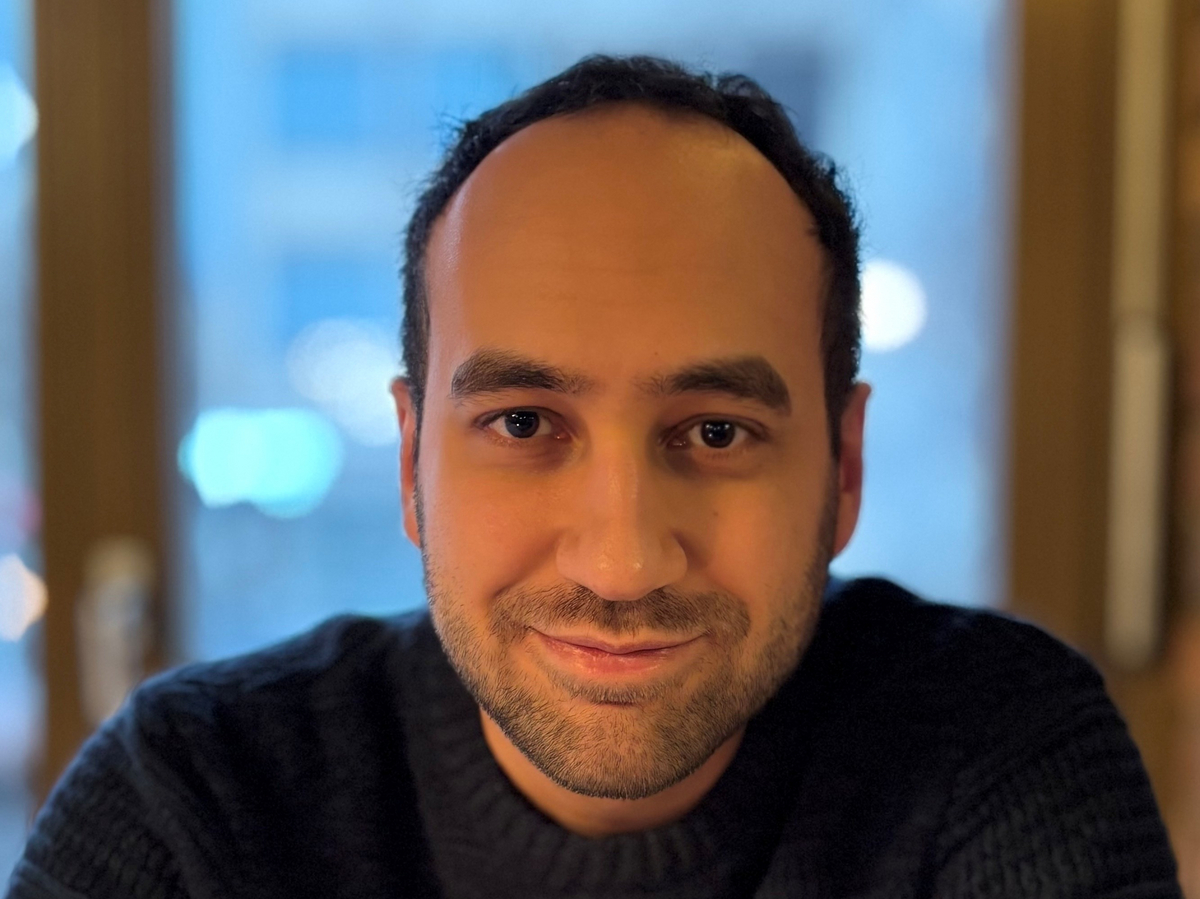
Dr. Barış Büyüktaş: is a federated learning researcher captivated by Nikola Tesla's knack for thinking decades ahead. A deep curiosity about AI under real-world constraints led him to BIFOLD, where he earned a summa cum laude doctorate in 2025 under Prof. Dr. Begüm Demir. His mission: building methods that let distributed AI systems grow smarter together, without sensitive satellite data ever leaving its source.
Three years later, on June 14, 2024, he published a preprint titled "Federated Learning Across Decentralized and Unshared Archives for Remote Sensing Image Classification," which represented his small novelty: "In this paper, as a first time in [Remote Sensing], we present a comparative study of state-of-the-art [Federated Learning] algorithms for [Remote Sensing] image classification problems" (Arxiv, 2024). His comparative review systematically compared state-of-the-art approaches and distilled them into a practical guide for selection.
With this, Barış added another building block to a foundation that the research community is still laying. The promise of federated learning in remote sensing is compelling: rather than consolidating petabytes of satellite imagery on central servers, each institution, whether a national surveying authority, a disaster response unit, or a regional environmental observatory, would train a local deep learning model on its own holdings and share only the resulting model updates. A central server would then merge these updates into a shared model that has effectively learned from all the data simultaneously, both reliably and communication-efficiently. In practice, however, this approach has yet to be widely adopted across the field.
Privacy rules were written to protect people, not to paralyze science. Federated learning honors both: it keeps data local and still delivers models that see the whole picture.
FedX: Teaching Federated Learning Models to travel light
In December 2025, Barış defended his doctoral thesis, "Advanced Federated Learning Methods for the Analysis of Remote Sensing Images Across Decentralized and Unshared Archives," summa cum laude. His dissertation tackles three challenges. First: which federated learning algorithms are actually worth using in remote sensing? Second: what happens when the distributed data is heterogeneous not only in content but also in modality? For instance, when one institution works with optical satellite imagery and another with radar data. His multimodal federated learning framework addresses precisely this. It introduces mechanisms that fuse and align data representations across different clients without the data themselves ever having to be shared. Third: how can the costs caused by the constant back-and-forth transmission of model updates be reduced? This is where FedX comes into play.
Communication overhead is one of the biggest practical hurdles for federated learning at scale. Every training round requires sending model updates, potentially millions of parameters, between the clients and the central server. For satellite networks with limited bandwidth, this is a fundamental bottleneck.
FedX addresses this problem by using explainability to guide pruning, the targeted removal of those model components that contribute least to the task at hand. Rather than relying on brute-force compression, the method identifies which parts of a model are actually relevant for the specific task. Using backpropagation-based methods, it estimates the importance of each component and removes the least important ones before transmission. The resulting slimmed-down model travels faster, needs less bandwidth, and, perhaps counterintuitively, often generalizes better than its unpruned counterpart. Metaphorically speaking, the pruning works like the editing of a manuscript. Striking the passages that contribute nothing to the text makes it shorter and more precise.
If federated learning is the future of privacy-friendly Earth observation, then communication costs are the decisive bottleneck on the way there. FedX doesn't just reduce these costs, it turns the constraint into a performance advantage.
Federated Learning: is a distributed machine learning approach where a shared model is trained across multiple clients without centralizing raw data. Each participant trains locally, sending only model updates to a server that aggregates them into a global model. This is especially valuable for Remote Sensing, where satellites produce vast, distributed datasets across institutions, enabling collaboration without compromising data sovereignty.
The Next Decade: Foundation Models, Federated
Barış is currently continuing his academic career at BIFOLD, where he remains part of the RSiM group. As a postdoctoral researcher, he is once again setting out for new shores: connecting two worlds in order to make foundation models compatible with federated learning. Foundation models were first presented in August 2021 by a research group at Stanford University. They are large AI models trained on vast amounts of data that serve as a universal basis for a wide variety of downstream tasks. Well-known examples of such models include OpenAI's GPT series. For the remote sensing domain, foundation models represent a breakthrough of a different kind. While federated learning changes how models are trained across institutions, without moving any data, foundation models change what is trained: powerful, versatile AI systems that learn broad patterns from enormous datasets and can then be adapted to specific tasks with very little additional data. Techniques such as parameter-efficient fine-tuning and prompt-based adaptation open up promising avenues, yet so far they have barely been explored in the context of remote sensing. But that, surely, is only a matter of time.
--
Three key works by Dr. Barış Büyüktaş
Federated learning across decentralized and unshared archives for remote sensing image classification: A review (GRSM, 2024). A comparative study of state-of-the-art Federated Learning algorithms for Remote Sensing image classification problems, and a guideline for selecting suitable FL algorithms in RS is derived.
A multi-modal federated learning framework for remote sensing image classification (TGRS, 2025). Introduces a novel Multimodal Federated Learning framework for Remote Sensing classification using iterative model averaging to enable training without client data access while addressing heterogeneity by aligning data distributions across clients.
FedX: Explanation-Guided Pruning for Communication-Efficient Federated Learning in Remote Sensing (IEEE J-STARS, 2026). Introduces FedX, a federated learning method for Remote Sensing that prunes task-irrelevant model components via backpropagation-based saliency at the server, cutting communication overhead while boosting global model generalization.