



Stefaan Hessmann

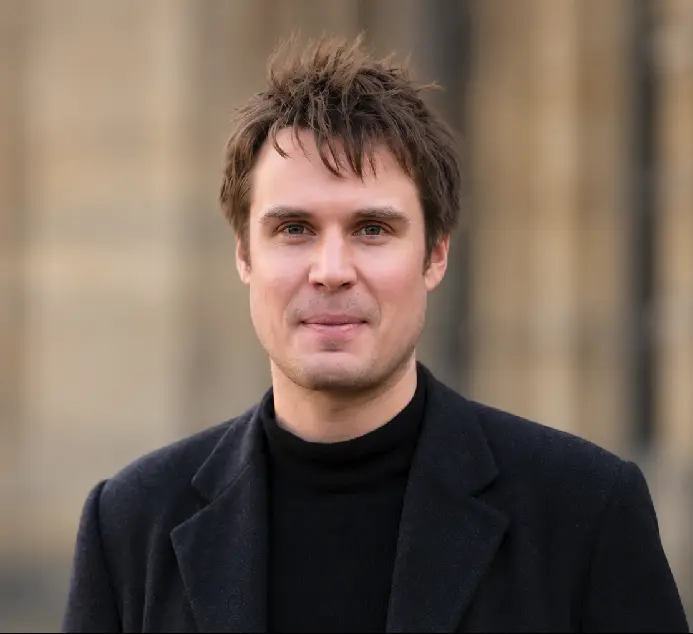
Stefaan Hessmann
Doctoral Researcher
Affiliation: BIFOLD
Stefaan Hessmann is a doctoral researcher at the Machine Learning group at Technische Universität Berlin. He obtained his Bachelor’s degree in Physics from Technische Universität Dresden and subsequently pursued his studies in Computational Sciences at Freie Universität Berlin. He has worked on active learning for materials generation and on generative models for molecular generation. At present, his research primarily focuses on the application of deep neural networks in the field of materials sciences, in particular on diffusion-based models for materials generation. He is also a developer of SchNetPack, an open-source toolbox for deep learning on molecules and materials.
Quantum Chemistry Deep Learning Materials Science Generative Models
Stefaan Simon Pierre Hessmann, Khaled Kahouli, Stefan Gugler, Michael Plainer, Frank Noé, Klaus-Robert Müller, Niklas Wolf Andreas Gebauer
Generative Pseudo-Force Fields for Molecular Generation
Stefaan S. P. Hessmann, Kristof T. Schütt, Niklas W. A. Gebauer, Michael Gastegger, Tamio Oguchi, Tomoki Yamashita
Accelerating crystal structure search through active learning with neural networks for rapid relaxations
Khaled Kahouli, Stefaan Simon Pierre Hessmann, Klaus-Robert Müller, Shinichi Nakajima, Stefan Gugler, Niklas Wolf Andreas Gebauer
Molecular relaxation by reverse diffusion with time step prediction
Kristof T. Schütt, Stefaan S.P. Hessmann, Niklas W.A. Gebauer, Jonas Lederer, Michael Gastegger
SchNetPack 2.0: A neural network toolbox for atomistic machine learning
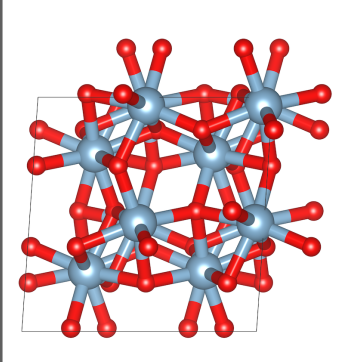
Guided exploration of chemical structures
The development of new, stable materials has enabled significant advancements across various research fields. A key challenge in this process is global energy optimization. The Agility Project "Guided Exploration of Chemical Space with Deep Neural Networks and Bayesian Optimization" has contributed to the advancement of current research in this area.