



Julius Hense

Julius Hense
Doctoral Researcher
PhD project: Responsible Machine Learning for Multimodal Medical Data
Machine learning has the potential to revolutionize healthcare. However, its clinical adoption is still hampered by various roadblocks, including insufficient model robustness, data efficiency, and explainability. Furthermore, medical domains often pose specific challenges that established machine learning algorithms do not account for. My research is focused on contributing to overcoming these challenges, aiming at making machine learning in healthcare more responsible. I am particularly interested in learning from multimodal medical data. More specifically, I aim to build ML systems that combine the analysis of medical images with other patient-centred data, such as electronic health records, time-series, or multi-omics data, and utilize them for downstream tasks like screening, diagnosis, or biomarker discovery. For that purpose, I work with techniques from multimodal machine learning, representation learning, and explainable AI, e.g., to design targeted multimodal fusion methods, compute low-dimensional representations of various medical data modalities, or uncover biological patterns across modalities. I specialize in applications for digital pathology and oncology, where I have the chance to collaborate with leading domain experts.
2020 - Hoare Prize for the best overall performance in the M.Sc in Computer Science 2020 at University of Oxford
2016 - 2020 Scholarship from “Studienstiftung des deutschen Volkes”
• Multimodal Machine Learning
• Representation Learning
• Explainable AI
• Computational Pathology
• Medical Image Analysis
Alexander Möllers, Marvin Sextro, Julius Hense, Gabriel Dernbach, Klaus-Robert Müller
In-Context Multiple Instance Learning
Tristan Lazard, Kenza Bouzid, Julius Hense, Shruthi Bannur, Daniel Coelho de Castro, Daniel Shao, Rajesh Jena, Drew Williamson, Stephanie Hyland
Sparse concept attribution for histomorphological hypothesis generation from whole-slide classifiers
Jonah Kömen, Edwin D. de Jong, Julius Hense, Hannah Marienwald, Jonas Dippel, Philip Naumann, Eric Marcus, Lukas Ruff, Maximilian Alber, Jonas Teuwen, Frederick Klauschen, Klaus-Robert Müller
 Towards Robust Foundation Models for Digital Pathology
Yanqing Luo, Julius Hense, Niklas Prenißl, Andreas Mock, Klaus-Robert Müller, Thomas Schnake, Mina Jamshidi Idaji
Symb-xMIL: Symbolic Explanations for Multiple Instance Learning in Digital Pathology
Mina Jamshidi Idaji, Julius Hense, Tom Neuhäuser, Augustin Krause, Yanqing Luo, Oliver Eberle, Thomas Schnake, Laure Ciernik, Farnoush Rezaei Jafari, Reza Vahidimajd, Jonas Dippel, Christoph Walz, Frederick Klauschen, Andreas Mock, Klaus-Robert Müller
Beyond Attention Heatmaps: How to Get Better Explanations for Multiple Instance Learning Models in Histopathology
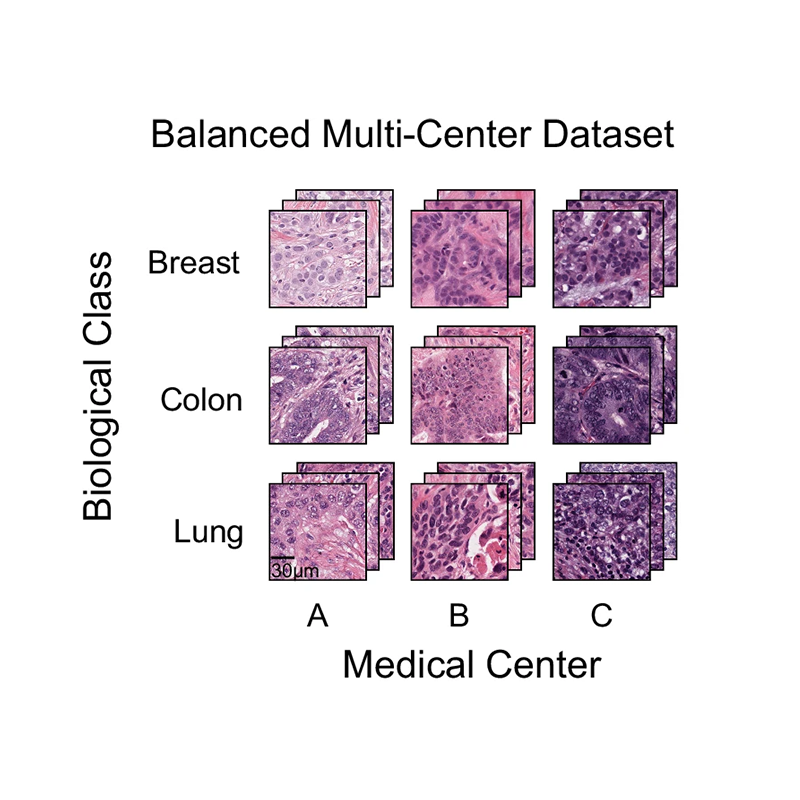
A benchmark for trustworthy clinical AI
A new study published in Nature Communications shows that today's pathology foundation models can be influenced by the origin of a tissue sample. Researchers at BIFOLD and Aignostics developed PathoROB, a first-of-its-kind benchmark to measure and reduce this bias, shaping how the next generation of pathology AI is built.
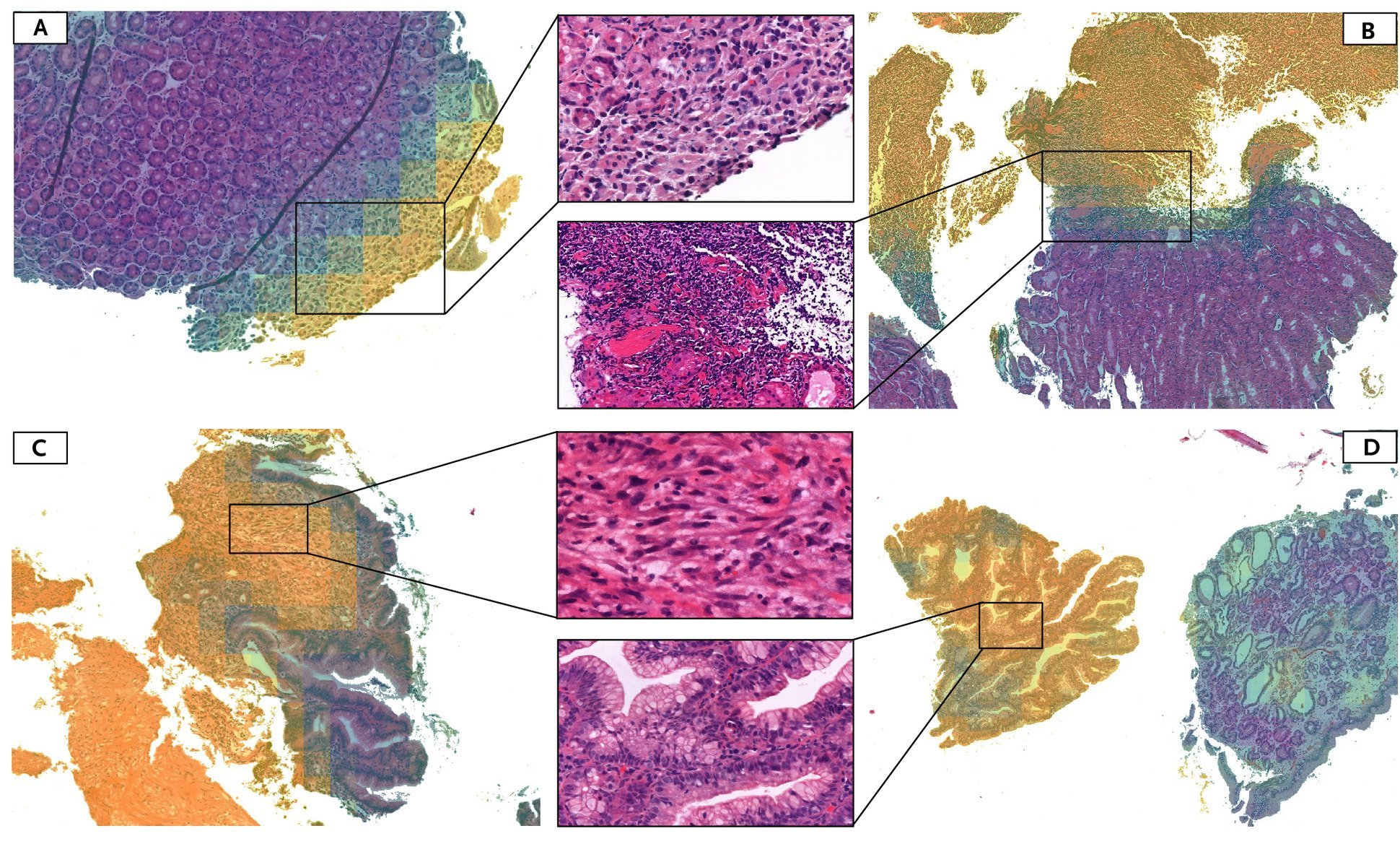
AI in medicine: new approach for more efficient diagnostics
Researchers from LMU, BIFOLD, and Charité have developed a new AI tool that uses imaging data to also detect less frequent diseases of the gastrointestinal tract. In contrast to conventional models, the new AI only needs training data from common findings to detect deviations.